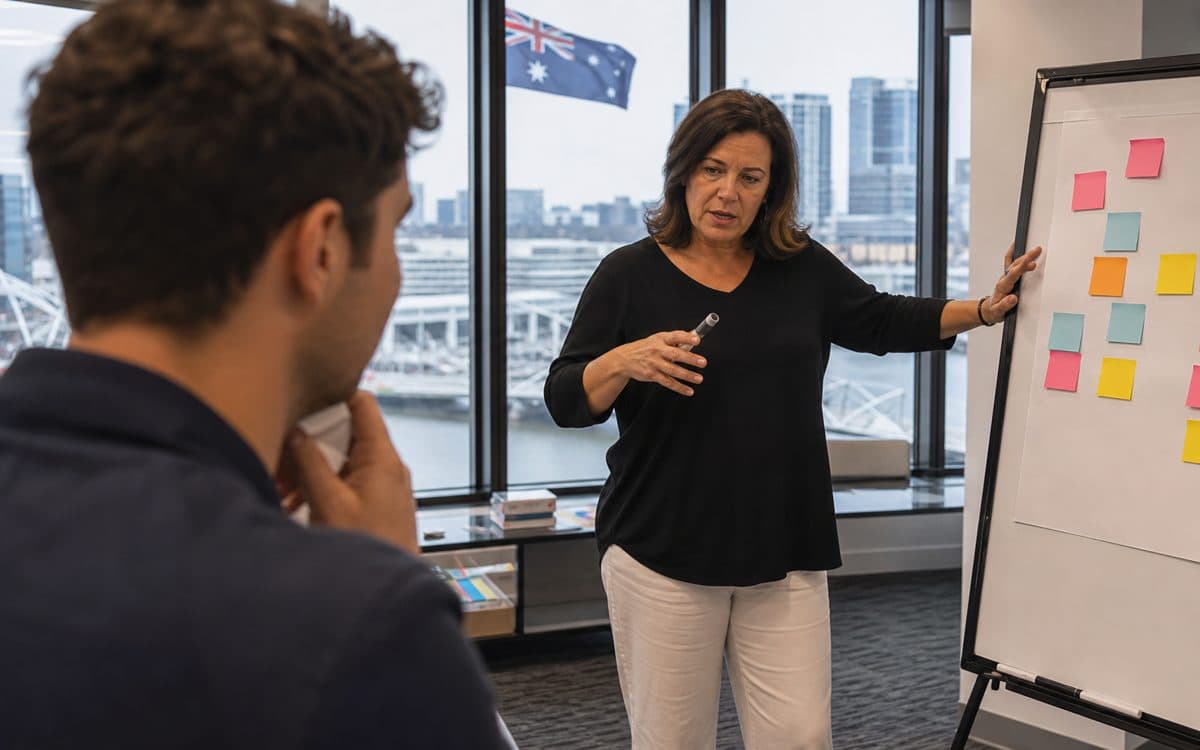
My First Day as a [Scrum Master](https://www.syncskills.com.au/blog/scrum-master-vs-product-owner-difference), I Had No Idea What I Was Doing
Building a scrum master career in Australia starts with a humbling realization: the theory and the reality are completely different animals. I'll never forget it. I started a new role on a Wednesday, and by Thursday I was sitting in a Scrum training session at SyncSkills, reviewing practice interview questions while simultaneously living them in real time.
Questions like: "What are the different roles in Scrum?" "Which skills does a Scrum Master need to be successful?" "Can you describe the specific duties a Scrum Master is responsible for?"
I could answer them because I'd studied. But the gap between studying the answers and actually living the role is where the real learning happened. Removing impediments sounds simple until you're sitting across from a developer who's been blocked for three days and nobody told you. Facilitating a retrospective sounds straightforward until seven people start arguing about what went wrong last sprint.
That's the scrum master career in Australia in a nutshell: you learn the theory, then you learn the reality. And the people who do well are the ones who bridge that gap quickly.
I'm Noah Oloja, and over the past several years, I've trained hundreds of people through our BA and Scrum Master programs at SyncSkills. Here's the guide I wish someone had given me.
What Does a Scrum Master Actually Do?
Let me cut through the jargon because this role is genuinely misunderstood.
A Scrum Master is a servant-leader who helps a team deliver work effectively using the Scrum framework. You're not the boss. You're not the project manager. You're the person who makes sure the team can do their best work by removing obstacles, facilitating conversations, and protecting the process.
Here's what that looks like day-to-day:
The Core Ceremonies
Daily Stand-ups (15 minutes, every day): You facilitate a quick team sync where each person answers three questions: What did I do yesterday? What am I doing today? Are there any blockers? Your job is to keep it focused and time-boxed. Most stand-ups go off the rails because the Scrum Master doesn't control the conversation.
Sprint Planning (2-4 hours, start of sprint): You facilitate the session where the team decides what work they'll commit to for the next sprint (usually 2 weeks). This involves estimating effort, understanding priorities from the Product Owner, and making sure the team doesn't overcommit.
Sprint Review/Demo (1-2 hours, end of sprint): The team shows stakeholders what they've built. You organize this, make sure the right people are in the room, and ensure feedback gets captured.
Sprint Retrospective (1-2 hours, end of sprint): This is where the magic happens. The team reflects on what went well, what didn't, and what to improve. A good Scrum Master creates psychological safety here so people are honest. A bad one lets it become a blame session.
Beyond the Ceremonies
The ceremonies are maybe 20% of the role. The other 80% is:
- Removing impediments -- When something is blocking the team (a missing decision from leadership, a system access issue, a dependency on another team), you're the one who goes and fights for a resolution
- Coaching the team -- Helping them self-organize, improve their processes, and build better working habits
- Protecting the team -- Shielding them from scope creep, unnecessary meetings, and organizational noise that prevents focused work
- Facilitating collaboration -- When there's conflict or miscommunication, you step in and help people work through it
- Tracking metrics -- Velocity, burndown charts, cycle time. Not to measure performance, but to help the team understand their own patterns
As we teach in our Scrum Master training: the skills you need are analytical skills, problem-solving skills, communication, facilitation, and leadership. Notice that none of those are technical. You don't need to code. You need to lead.
[Scrum Master Salary](https://www.syncskills.com.au/blog/scrum-master-salary-australia-2026) in Australia: The Full Breakdown
Let's talk money, because that's probably why you're researching this career path.
Salary Progression
- Entry-level / Junior Scrum Master: $80,000 -- $100,000
- Mid-level Scrum Master (2-3 years): $110,000 -- $130,000
- Senior Scrum Master (4+ years): $130,000 -- $155,000
- Agile Coach / Lead: $150,000 -- $180,000+
- Contract rates: $700 -- $1,100+ per day
For context, a mid-level Scrum Master earning $120,000 takes home about $4,437 per fortnight. From one job. No night shifts. No weekend rosters. No agency calls on Christmas day hoping for double time.
I always ask people in our webinars: "Can you see a life where you don't have to work multiple jobs? Where you work Monday to Friday and actually have your evenings and weekends?" For the 240+ people who've transitioned through SyncSkills, that's not a fantasy. It's their reality.
Where the Highest Salaries Are
Banking and Finance: The big four banks (CBA, ANZ, Westpac, NAB) and financial services companies are consistently the highest payers for Scrum Masters. They run massive Agile transformations and need experienced facilitators.
Government (Federal and State): Government digital transformation projects are everywhere. Queensland Government, NSW, Victoria -- all hiring Scrum Masters at competitive rates. These roles often come with stability and work-life balance that private sector can't match.
Telcos and Tech: Companies like Telstra, Atlassian, and the growing Australian tech ecosystem pay premium rates for Scrum Masters who understand both the framework and the technology.
Consulting: Firms like Accenture, Deloitte, PwC, and specialized Agile consultancies hire Scrum Masters for client-facing roles. The pay can be higher but the hours can be longer.
Contract vs. Permanent
Many experienced Scrum Masters in Australia go the contract route for higher daily rates. A contract Scrum Master earning $900/day over 230 working days in a year makes over $200,000. Even accounting for the lack of leave entitlements and super, that's significantly more than most permanent positions.
But contracts come with uncertainty. No guaranteed work between contracts, no paid leave, no employer super contributions. Most people start permanent, build their reputation and network, then consider contracting once they have a solid track record.
[How to Become](https://www.syncskills.com.au/blog/how-to-become-scrum-master-australia-no-experience) a Scrum Master in Australia (The Realistic Path)
Here's the path that actually works, based on training hundreds of people through this exact transition.
Phase 1: Learn the Framework (Weeks 1-4)
Before anything else, you need to understand Scrum deeply. Not just the ceremonies -- the principles behind them.
Key concepts you must master:
- The three roles: Scrum Master, Product Owner, Development Team. Know the boundaries and responsibilities of each.
- The five events: Sprint, Sprint Planning, Daily Scrum, Sprint Review, Sprint Retrospective. Know the purpose, time-box, and desired outcomes of each.
- The three artifacts: Product Backlog, Sprint Backlog, Increment. Know how they connect and who owns each.
- Scrum values: Commitment, Focus, Openness, Respect, Courage. These aren't fluff -- they're the behavioral foundation that makes Scrum work.
Where to learn: A structured training program will cover this faster and more practically than self-study. In our SyncSkills program, we cover all of this alongside hands-on practice, not just theory.
Phase 2: Build Practical Skills (Weeks 4-8)
Knowing Scrum theory is like knowing the rules of football. It's necessary but not sufficient. You need practice.
This is where most Scrum Master aspirants fall short. They study for a certification exam, pass it, and then have no idea what to do when they're actually in the role.
Practical skills to develop:
- Facilitation: Practice running meetings with time constraints, managing dominant voices, drawing out quiet participants
- Conflict resolution: Learn how to address disagreements constructively without taking sides
- Communication: Corporate communication is different from casual conversation. The way you email, the way you present, the way you escalate issues -- all of this needs to sound professional and confident
- Stakeholder management: Understanding who has power, who has influence, and how to navigate organizational dynamics
Observing how experienced professionals communicate is a skill in itself. For example, someone who has never worked in a corporate environment might pay close attention to the language, professionalism and tone their trainers and mentors use when navigating complex conversations. They can then carry those habits straight into their first Scrum Master role.
That's the kind of learning that no certification exam tests for. But it's exactly what determines whether you succeed in the role.
Phase 3: Get Certified (But Strategically)
Thinking about a career in Business Analysis?
Our AI BA Training has helped 267+ immigrants land BA roles at companies like Westpac, Accenture, and Telstra.
Explore AI BA TrainingCertifications matter in the Scrum Master world, but not all certifications are created equal. Here's my honest assessment:
Worth getting:
- PSM I (Professional Scrum Master, Scrum.org): $150 USD. Rigorous exam, well-respected, no required course. The best value certification in the Scrum world.
- CSM (Certified ScrumMaster, Scrum Alliance): ~$1,000-$1,500 AUD including mandatory 2-day course. The most recognized name in the market. Some employers specifically ask for CSM.
Worth considering later:
- PSM II / PSM III: Advanced certifications that demonstrate deeper expertise. Good for career progression but not necessary to get started.
- SAFe Scrum Master: Relevant if you're targeting large enterprises that use the Scaled Agile Framework. Many banks and government departments use SAFe.
- ICP-ACC (ICAgile Coaching): Useful if you want to move toward Agile Coaching.
Not necessary to start:
- Multiple certifications from multiple bodies. One good certification plus practical skills beats three certifications with no experience.
Here's my view: get PSM I or CSM to open doors. Then let your practical skills and results do the talking. No employer has ever said, "We would have hired you but you only had one Scrum certification instead of four."
Phase 4: Land Your First Role (Weeks 8-16)
This is where positioning matters more than credentials.
Your resume needs to tell the story of someone who can facilitate, communicate, and lead. Not someone who memorized the Scrum Guide.
Focus on:
- Facilitation experience (meetings you've run, workshops you've organized -- even outside of formal Scrum)
- Problem-solving examples (conflicts you've resolved, obstacles you've removed)
- Communication skills (presentations you've given, documents you've written, stakeholders you've managed)
- Any project coordination experience (even from non-tech roles)
Interview preparation is critical. Scrum Master interviews typically include:
- Scenario-based questions ("What would you do if a team member isn't participating in stand-ups?")
- Framework knowledge ("Explain the difference between Sprint Review and Retrospective")
- Behavioral questions ("Tell me about a time you resolved a conflict")
- Cultural fit ("How do you handle pushback from senior leadership?")
We run intensive interview prep in our program because I've seen too many qualified candidates bomb interviews by being unprepared. The knowledge is there -- the delivery isn't. And delivery is learnable with practice.
The Scrum Master to Agile Coach Pipeline
Many Scrum Masters in Australia eventually move into Agile Coach or Agile Lead roles. This is where the serious money and influence live.
The progression typically looks like:
- Scrum Master (1-3 years): Working with one or two teams
- Senior Scrum Master (3-5 years): Working with multiple teams, mentoring junior SMs
- Agile Coach (5+ years): Working across an organization, coaching leaders and teams on Agile adoption
- Head of Agile / Agile Transformation Lead (7+ years): Leading enterprise-wide Agile transformations
Each step up adds responsibility, influence, and compensation. An Agile Coach at a major Australian bank can earn $160,000 to $200,000+ in a permanent role, or $1,200+ per day as a contractor.
But the jump from Scrum Master to Agile Coach requires more than just years of experience. It requires:
- Deep understanding of multiple Agile frameworks (Scrum, Kanban, SAFe, LeSS)
- Coaching skills (not just facilitating -- actually developing people)
- Organizational change management experience
- The ability to influence senior leadership without positional authority
- A track record of measurable improvements in team performance
Why Scrum Masters Are in Demand (And Will Stay in Demand)
Some people worry that the Scrum Master role is a fad. It's not, and here's why:
Every organization undergoing digital transformation needs people who can help teams work effectively in iterative, collaborative ways. As long as organizations are building software, launching products, and managing complex projects, they need Scrum Masters.
Australian government at all levels is doubling down on Agile delivery. Banks are mid-transformation and need Scrum Masters for years to come. Tech companies are growing. Even non-tech companies (retail, healthcare, education) are adopting Agile practices.
The role might evolve -- more AI integration, more coaching focus, more strategic influence. But the core need for someone who helps teams deliver effectively isn't going away.
---
You might also like
Frequently Asked Questions
Can I become a Scrum Master without a technical background?
Absolutely. The Scrum Master role is about facilitation, leadership, and process -- not coding. Many of our most successful Scrum Masters came from backgrounds in nursing, teaching, accounting, and support work. The transferable skills you bring (communication, problem-solving, team coordination) are the foundation of the role.
Which Scrum Master certification should I get first in Australia?
Start with either PSM I from Scrum.org ($150 USD, self-study, rigorous exam) or CSM from Scrum Alliance (~$1,000-$1,500 AUD including mandatory training). PSM I is better value. CSM has higher brand recognition. Either one will open doors for your first role.
How long does it take to become a Scrum Master?
With focused training, you can be interview-ready in 8 to 12 weeks. The full transition from zero to employed typically takes 3 to 6 months. This is significantly faster than a university degree and produces better employment outcomes for career changers.
Is Scrum Master a good career for immigrants in Australia?
Yes. It's one of the best paths we've seen for immigrants because the role values soft skills that you already have -- communication, cultural awareness, adaptability, and facilitation. The Scrum framework is global, so your understanding of it is valid everywhere. And Australian organizations are actively seeking diverse perspectives in their Agile teams.
What's the difference between a Scrum Master and a Project Manager?
A Project Manager plans, controls, and directs work. They own the timeline, budget, and scope. A Scrum Master facilitates and coaches. They help the team self-organize and deliver iteratively. In practice, there's overlap -- many organizations hire Scrum Masters to do project management work and vice versa. Understanding both roles makes you more versatile and more employable.
Your Move
The scrum master career path in Australia is one of the most accessible routes to a six-figure career that doesn't require coding, a specific degree, or years of Australian experience.
The demand is real. The salaries are real. The pathway is proven -- not by theory, but by the hundreds of people who've made this transition through our programs.
If you're working a job right now that doesn't reflect what you're capable of, if you're exhausted by the grind of multiple shifts and uncertain rosters, or if you simply want a career where your communication skills and leadership ability are actually valued and compensated -- this is the path.
Register for our next free masterclass at syncskills.com.au and see how people with backgrounds just like yours have transitioned into Scrum Master roles paying $130,000 and above.
The framework is simple. The certification is achievable. The opportunity is massive. The only question is whether you'll take the first step.