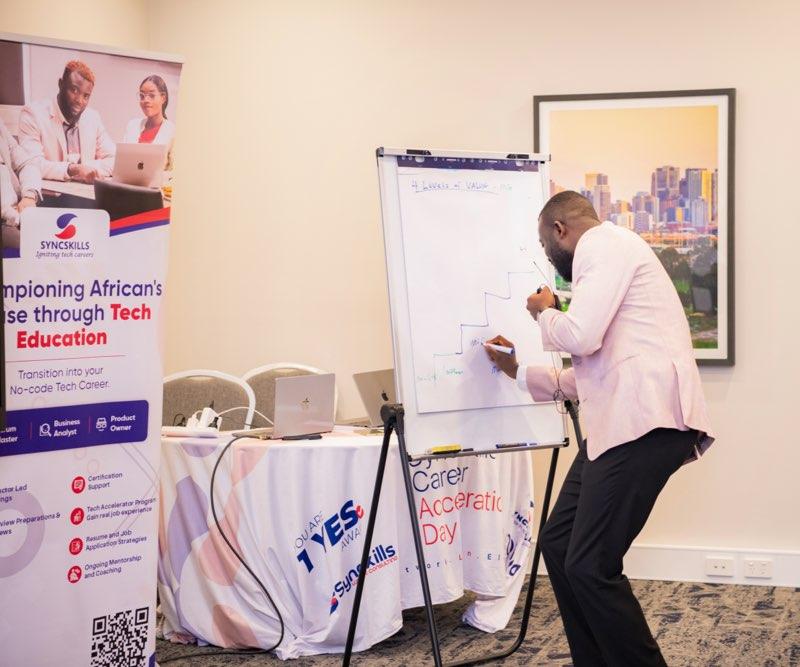
At one of our webinars, Noah told a story about a man who'd messaged him on TikTok. He wanted to pay for his wife to do a master's degree so she could become a project manager in Australia.
Noah asked him one question: what's the goal? "To get her a job. To make sure she actually has a career as a project manager." Then Noah asked the room: "How many of you have a master's degree today and still struggle to get your dream job?" The chat filled up with yeses.
If you're searching for an online Master of Project Management right now, you're probably in the same spot as that couple. You want the career, and the degree looks like the safest way in. Here's an honest look at what you get, what it costs, and when it's genuinely worth it.
Quick answer
For career changers with no project experience, a Master of Project Management is usually not worth it as the main route in. Online options list about $39,000 to $41,000 in 2026 indicative tuition over one to two years, and they teach theory, not the project experience Australian employers screen for. It's worth it mainly if you already work in projects.
Key facts at a glance
- UNSW Canberra's online Master of Project Management lists a 2026 indicative full fee of $41,000, over one year full-time.
- Southern Cross University's online version lists $39,000 for 12 subjects over two years part-time, and asks for a bachelor's degree plus two years of professional experience, or more than five years' experience.
- Ordinary permanent residents generally can't use HELP loans except for bridging study, according to Study Assist.
- The Australian Institute of Project Management describes itself as Australia's national peak body for the project profession and offers its own certifications, such as CPPP and CPPM.
- According to SyncSkills' Graduate Outcomes Report, across 28 documented graduates the median time from starting the program to landing a role was 4.5 months, and 27 of 28 started on $100K or more.
Updated November 2026.
What an online PM master's actually gives you
A good master's teaches you the language and frameworks of project management: scope, schedule, cost, risk, stakeholders, governance, Agile methods. You'll write assignments, maybe a capstone. You'll finish with a recognised postgraduate qualification.
Here's what the course pages say, in plain numbers:
| UNSW Canberra (online) | Southern Cross University (online, via OUA) | |
|---|---|---|
| 2026 indicative fee | $41,000 full fee | $39,000 total |
| Length | 1 year full-time, or part-time equivalent | 12 subjects, 2 years part-time |
| Entry | See the university handbook | Bachelor's plus 2 years' professional experience, or 5+ years' experience |
Sources: UNSW Canberra and Open Universities Australia.
Notice that second entry requirement. Some programs expect you to already have professional experience before they'll let you in. That tells you who these degrees are really designed for: people building on a career they already have.
What it doesn't give you
Tayo summed up the gap on a webinar: "The classroom is different from what the organisation wants to hire you for."
In a project manager interview in Australia, the questions sound like this: "Tell us about a project you delivered. How did you handle a stakeholder who disagreed with you? What did you do when the budget blew out?" Noah puts it bluntly: "If you want 120,000 dollars, the interview question is going to be: tell us about your experience working on XYZ project. What have you done? If you haven't done it before, what do you have to talk about?"
A master's gives you case studies about other people's projects. It doesn't give you:
- A project you delivered in an Australian context, with real stakeholders.
- A referee who can tell an employer you did the work. In Australia, the reference check is usually the last step before an offer.
- Positioning. How to turn your overseas experience and transferable skills into a story an Australian hiring manager believes.
That's why so many of the people we meet have a master's and still can't get an interview. One prospect told us he had "a bachelor's in mechanical and a master's in mining, but no experience in both."
The money question for migrants
For Australian citizens, a master's can go on a FEE-HELP loan and get repaid through tax. For many migrants, it can't. Study Assist says ordinary permanent residents generally can only use a HELP loan for bridging study. If you're on a temporary visa, the picture is usually tighter again, so check your own eligibility with the university.
So for a lot of our readers, $39,000 to $41,000 means real savings, gone, plus one to two years before you've finished. Add the income you're not earning in a better role during that time. Our breakdown of what a career change really costs in Australia puts all of those numbers side by side.
When a Master of Project Management IS worth it
We're not anti-degree. Noah has two master's degrees. A PM master's makes good sense if:
- You already work in projects and want to move into senior or program roles, where a postgraduate qualification can support a promotion.
- Your employer is paying or giving study leave.
- A registered migration agent has told you a specific qualification helps your visa situation. That's their call, not ours.
- You're aiming at roles that list it as a requirement, which you've confirmed by reading real job ads, not assumptions.
- You love the subject and the money won't strain your family.
When it isn't
It's usually the wrong first move if:
- You have no project role on your CV and you're hoping the degree will get you one.
- You already have a degree that isn't being used. As Noah said on that webinar: "Master's degrees don't get you opportunity. I can show you hundreds of people that have done the master's and are stuck."
- You'd be paying from savings you need as a buffer.
- What you really need is interview confidence and local experience, not more theory.
What gets career changers into project roles instead
You probably have more project experience than you think. Tayo uses a simple example on webinars: planning a wedding. Someone has to track the budget, manage the suppliers, plan for rain, and keep the family happy. That's scope, cost, risk and stakeholder management. Nurses coordinate care plans. Support workers manage rosters and incidents. Engineers deliver to deadlines and specifications.
What turns that into a project career is the framework Noah teaches, MSEP: Mindset, relevant Skills, proven Experience and Positioning. Miss one and you struggle.
- Learn the skills live, with feedback. Agile, Scrum, stakeholder management, project artefacts, and the tools Australian teams use, like Jira and Confluence.
- Get real experience. Work on real projects in a team, so you have something true to say when they ask "tell us about a project you delivered."
- Position yourself. Translate your past roles into project language, and practise your story until it's natural.
- Use the stepping stones. Many people enter through business analyst, Scrum Master or project coordinator roles, then move up. Our guides on moving from project coordinator to project manager and becoming an IT project manager with no experience map those routes.
Emem Inyang's published story shows what's possible when skills, experience and positioning come together. She'd been unemployed for three months. Three months after starting with us, she was choosing between offers: "I went from unemployed for 3 months to $152K at Westpac. Imagine for a second 2 companies are begging for you to accept their offer: Westpac at $152K or another job at $130K."
Compare that with Aboy R., who already had a postgraduate business degree: "After graduating with an MBA in Nigeria, I couldn't land a tech role in Australia… I'm now at Accenture." The MBA alone didn't get him in.
If you're weighing up courses generally, our project management course guide lists the main options, and how to become a project manager in Australia covers the full path.
Frequently Asked Questions
Is an online Master of Project Management worth it in Australia?
It's worth it if you already work in projects and want to move into senior roles, or if your employer is paying. For career changers with no project experience, it's usually not the best first step, because it costs around $39,000 to $41,000 and doesn't give you the delivered projects, referees and interview stories employers look for.
How much does an online Master of Project Management cost?
Two 2026 examples: UNSW Canberra lists an indicative full fee of $41,000 for one year full-time online, and Southern Cross University, through Open Universities Australia, lists $39,000 for 12 subjects over two years part-time. Fees change each year and depend on your residency status, so check the university's own fee page before you apply.
Can I become a project manager without a master's degree in Australia?
Yes. Employers mainly hire project managers on delivered work, not on the degree. Career changers often move in through business analyst, Scrum Master or project coordinator roles, using transferable skills from nursing, engineering, admin, support work or teaching. What matters is relevant skills, real project experience you can talk about, and positioning your background clearly.
Can permanent residents get FEE-HELP for a Master of Project Management?
Generally not. Study Assist says ordinary permanent residents can access HELP loans only for bridging study. Permanent humanitarian visa holders have different rules. If you're a permanent resident, expect to pay a master's upfront unless the university tells you otherwise, and confirm your eligibility before enrolling.
Do I need PMP or a master's to get a project manager job?
Neither is a must for most roles. Many senior certifications expect years of project experience before you can sit them. Employers mainly want evidence you can deliver: projects you've worked on, how you handled stakeholders and risks, and a referee who'll back you. Build that evidence first, then add certifications if a role asks for them.
Talk to us
If you want help working out whether a PM master's or a faster route makes sense for you, watch the free training at syncskills.com.au/f/webinar, book a call at syncskills.com.au/book-a-call, or call or WhatsApp the team on 0493 315 746.