


## The Thesis: Skill Stacking in High-Growth, No-Code Roles
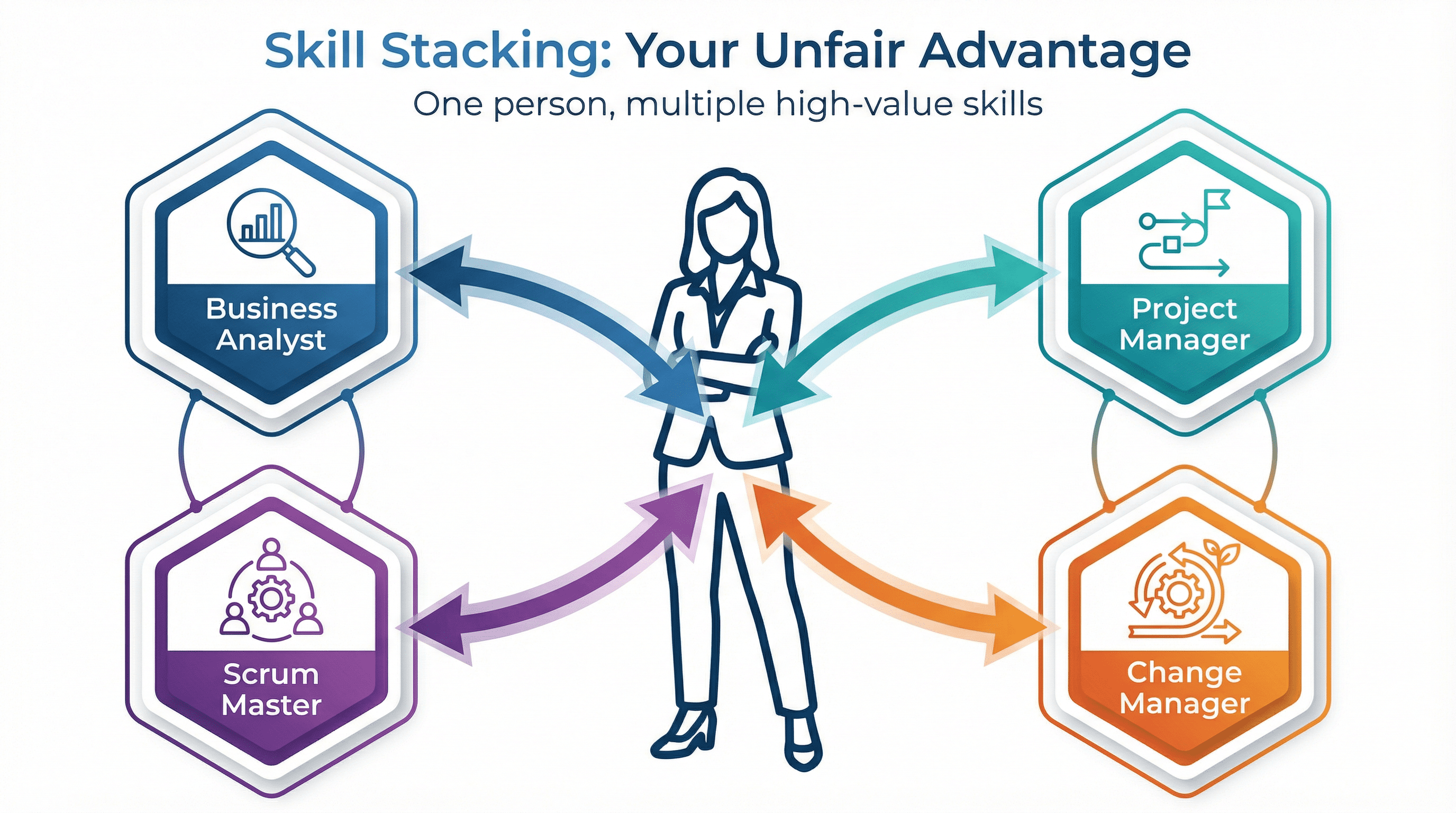
Many people can be great project managers, business analyst professionals, and role-specific individually. Where we help them win is the concept of **Skill Stacking**.
A business that wants to grow would hire a business analyst to bring about clarity, engage with both technical and non-technical stakeholders to identify the need, pain point, and bring about positive change.
The implementation happens within a project or business as usual—but you may say, what is a project?
A project is a temporary endeavor that is done to deliver an outcome. For example, a business may want to implement a system so they can manage their customer data properly. Maybe currently it is stored in a spreadsheet.
The problem with this is, imagine a growing company with thousands of customers managing that data with a spreadsheet or Excel is going to be ineffective, prone to error, and affect the business. So they need what we call a Customer Relationship Management system (CRM)—oh, you may have heard of it.
But first, we probably don't all know what the requirements of this system should be. That's where the **Business Analyst** comes into the picture to interview different stakeholders—AKA people that work in the company and have an interest in the project.
Then there's a question: who will organize all these people properly so they respond to requests, interviews, and send their feedback on time? You guessed it, a **Project Manager**.
And they are very important, else the project fails. But can you picture the chaos if there is nobody coordinating? Nothing will work because everybody will say, "Oh, I am busy, we do not have time to respond yet." So the project manager is like an event planner that organizes everyone to do their job.
---
## The Scrum Master & Change Manager
But then there's another role we should talk about: **Scrum Masters**. If this project is being run in a company that says the method we want to use to implement this project is **AGILE**—a technical word for saying, we do not want to do all the planning of this project upfront where everything is planned in the TRADITIONAL way, like how an event planner will have to plan everything upfront for how an event should go, so the decorator does not come after the event is in progress.
Agile says, because we are building a system that may change frequently like software does, and we may not know everything we want upfront because we change our minds about requirements often, let us plan for work that we can deliver real outcomes between 1-4 weeks and get feedback and improve from there until we complete the project.
That would give us flexibility to allow people to change their minds, implement feedback, and improve without too many risks, because adding a new room to a house build when the foundation is completed is WAY harder.
That person that implements Agile in the team is called a **Scrum Master**. You see, it's similar to a project manager but in a different context. I know what you are thinking now—don't worry, you do not have to do any form of coding. It's more of leading a team and helping them do their work better.
But when you know a project would introduce a change, right? And many people hate or resist changes—that's why for us to get the best outcomes from projects, to deliver the outcomes we want, we must manage people.
Be honest with me, you probably have resisted changes before, right? Yes, remember that time they told you, this is now the new way to do things, and you said, oh no, I like how I have been doing it, or a new system that you don't want. Eh it's okay, I am guilty as well.
So yeah, if nobody is explaining the changes, why it is important, and helping people see the value the new changes would bring, then people would resist the change and the project would fail. We do not want that, right? Yes, absolutely. That's why we have someone called the **Change Manager**.
They ensure they manage change properly so projects succeed and we get the buy-in of everyone.
---
## The Unfair Advantage: Skill Stacking
Now, these are some of the no-code tech roles that are high-growth and offer high income. Sometimes an organization is growing and cannot afford to hire all these roles individually.
We are thinking of those organizations as well, so as we have worked with thousands of people now, we are always thinking about Jane and David. We want you to adopt the principle of **Skill Stacking**, where you have a combination of these skills to give you an unfair advantage.
It's going to be rare to find someone that would have your unique skillset where you can perform as a BA, PM, Scrum Master, Change Manager, etc.
**These roles do not need you to know one line of code**, no need for prior experience in Tech, no degree needed, no technical jargon. You want something you can use your prior experience and skills.
People see these roles as tech roles, but we see them as **business skills**, and that matters a lot because businesses and organizations would always pay people to add value.
In fact, many of the people working in these roles that are senior level earn more than people that code. You can see by now that in fact, they are the ones that will LEAD the people that are doing all the technical and operational work to deliver. They typically get paid more than the developers.
---
## Our Philosophy: We Only Optimize You for 6-Figure Opportunities
We made a bet on the outcome that you absolutely have gifts and talents to do great things in your career. You have the potential to secure a **$120,000 - $159,000** career within 6 months working with us.
As of today, we have proven it with **251 success stories**—real people that have changed their lives in as little as 3-6 months working with us to build the skills, develop the communication, and technique to secure the dream job.
But let me make it absolutely clear why you should avoid what other coaches and gurus tell you about getting your foot in the door. Many coaches will tell you to just get the entry-level role for a start.
**It's a trap and hard to recover from.**
You are here to be HAPPY and fulfilled, not to just manage.
### The Entry-Level Trap
**1. Competition is Highest at the Bottom**
Every growing business or organization runs on skilled and talented professionals. They want the best. So imagine if there are 100 employees working. Entry-level roles would be between 5-10 at best, so you can see it's a small slot compared to experienced roles.
Check any job boards—Seek, Indeed, LinkedIn: Entry-level roles pay between $50-69k a year. Is that what you want?
You compete with:
- Freshers
- Local graduates
- Other career changers
- Everyone else thinking entry-level roles
Where is your leverage here?
Assuming you even got the job as entry-level, picture this:
- You won't get respected as the seniors, and you are already probably very educated right now—BSc, MSc, even PhD
- Can you see where I am going with this? You will even work the hardest because you are the one everyone wants to send on errands, the untidy work, not leverage work
- Worse part, now even if you want to move jobs, your payslip is locked at the lower pay scale, and getting to 6-figures becomes a longer route if you are not strategic
---
## What About Cyber Security, Data Science, or Data Analyst Roles?
Well, these are high-growth roles, but let's be honest, Jane and David are busy people who are probably working multiple jobs right now, looking after kids, have other priorities, and do not want technical stuff that is hard to master.
These roles require you to master some tools, and you need to be able to use them in an experienced way. You can learn these skills in 3-6 months, but it's tougher to master all the techniques and concepts, and the experience you have in other roles is not easily transferable to these roles.
That's why I love those no-code roles a lot, because irrespective of your skills, experience, or competence, you can learn what is required to perform at a high level and leverage your gifts to secure 6-figure roles.
You can't get a 6-figure salary with 3 months of learning cyber security. So what do you want?
---
## Our Mission: Long-Term Sustainability
Our goal is long-term sustainability. It's not about roles for us—it's a mission-driven approach.
There is a problem where gifted, talented people are in jobs that suck and drain their energy. They are not able to innovate and grow.
We want you to:
**Level 1:** SKILL STACK in no-code roles, have more leverage than anyone else, and then secure a dream job that pays you for your VALUE, not your time. That's Level 1 unlocked.
**Level 2:** Do incredible work in your organizations, build networks, grow, and then INNOVATE around the opportunities you see so you can have Ownership.
Ownership is the goal. Ownership means you can now transition your skills to solving problems for the world and going the entrepreneurship route. That is genuinely when you will have freedom.
We have many people like Jane and David that we have helped achieve this incredible outcome you may be wanting.
---
## Ready to Start Your Journey?
- [Explore Our Programs](#)
- [Take Our Career Quiz](#)
- [Book a Free Consultation](#)
