


Introduction: Australia's Game-Changing New Visa Pathway
On December 7, 2024, the Australian government announced a major reform to its skilled migration system with the launch of the Skills in Demand (SID) visa. This new visa replaces the Temporary Skill Shortage (TSS) subclass 482 visa and represents the most significant change to Australia's skilled migration framework in years. For professionals in no-code tech roles—Business Analysts, Project Managers, Scrum Masters, and Change Managers—this visa opens up unprecedented opportunities for career advancement and permanent residency pathways.
This comprehensive guide will walk you through everything you need to know about the Skills in Demand visa, including eligibility requirements, application processes, pathways to permanent residency, and specific considerations for tech professionals. Whether you are currently in Australia on a different visa or planning to migrate, understanding this new visa framework is essential for your career planning.
What Is the Skills in Demand Visa?

The Skills in Demand visa is a new employer-sponsored temporary visa designed to address critical skill shortages across the Australian economy. It replaces the TSS (subclass 482) visa and introduces a more streamlined, flexible framework that better aligns with Australia's economic needs.
The visa has three distinct streams, each targeting different skill levels and offering different pathways to permanent residency. What makes this visa particularly attractive for tech professionals is its focus on occupations that are in high demand, including Business Analysts, ICT Project Managers, and other no-code tech roles.
Unlike previous visa frameworks that often created uncertainty around permanent residency pathways, the Skills in Demand visa provides clear, structured routes to becoming a permanent resident of Australia. This makes it an attractive option for professionals who want long-term career stability and the ability to build a life in Australia.
The Three Streams of the Skills in Demand Visa
Understanding the three streams is crucial because your occupation, salary, and career goals will determine which stream you are eligible for and which pathway to permanent residency you can pursue.
Specialist Skills Stream
The Specialist Skills stream is designed for highly skilled professionals in occupations that are critical to Australia's economy. This stream offers the fastest pathway to permanent residency and is ideal for experienced professionals in senior or specialized roles.
Key Features:
- Requires occupation to be on the Core Skills Occupation List (CSOL)
- Minimum salary threshold of $135,000 AUD annually (as of 2024)
- Pathway to permanent residency after three years
- Visa validity of up to four years
- Includes family members (spouse and dependent children)
Relevant Occupations for No-Code Tech Professionals:
- ICT Business Analyst (ANZSCO 261111)
- ICT Project Manager (ANZSCO 135112)
- Systems Analyst (ANZSCO 261112)
If you are earning or can negotiate a salary above $135,000, the Specialist Skills stream is your best option. It provides the most direct route to permanent residency and offers the greatest flexibility in terms of employer changes and career progression.
Core Skills Stream
The Core Skills stream targets mid-level professionals in occupations that are consistently in demand across Australia. This is the most relevant stream for the majority of Business Analysts, Project Managers, Scrum Masters, and Change Managers.
Key Features:
- Requires occupation to be on the Core Skills Occupation List (CSOL)
- Minimum salary threshold aligned with the Annual Market Salary Rate (currently around $73,150 AUD)
- Pathway to permanent residency after four years
- Visa validity of up to four years
- Includes family members
Relevant Occupations for No-Code Tech Professionals:
- Business Analyst (ANZSCO 261111)
- ICT Project Manager (ANZSCO 135112)
- Management Consultant (ANZSCO 224711) - often applicable to Change Managers
- Organisation and Methods Analyst (ANZSCO 224712)
The Core Skills stream is where most no-code tech professionals will find their pathway. The salary threshold is achievable for mid-level professionals, and the four-year pathway to permanent residency provides a clear timeline for planning your future in Australia.
Essential Skills Stream
The Essential Skills stream is designed for workers in occupations that are essential to specific industries but may not require the same level of formal qualifications as Core or Specialist roles. This stream is less relevant for tech professionals but is included here for completeness.
Key Features:
- Requires occupation to be on a specific Essential Skills list
- Lower salary thresholds
- Limited pathway to permanent residency (requires transitioning to another visa)
- Shorter visa validity (typically two years)
For Business Analysts, Project Managers, Scrum Masters, and Change Managers, the Essential Skills stream is generally not applicable. Your focus should be on qualifying for either the Core Skills or Specialist Skills stream.
Eligibility Requirements for No-Code Tech Professionals
To qualify for the Skills in Demand visa, you must meet several key requirements. Understanding these requirements will help you assess your readiness to apply and identify any gaps you need to address.
Occupation on the Relevant List
Your occupation must be listed on either the Core Skills Occupation List (CSOL) or the Specialist Skills Occupation List. The good news is that most no-code tech roles are included:
- Business Analyst (ANZSCO 261111): Listed on CSOL
- ICT Project Manager (ANZSCO 135112): Listed on CSOL
- Systems Analyst (ANZSCO 261112): Listed on CSOL
- Management Consultant (ANZSCO 224711): Listed on CSOL (often used for Change Managers)
It is important to note that your job title does not need to exactly match the ANZSCO occupation title. What matters is that your actual duties and responsibilities align with the occupation description. For example, if your job title is "Agile Coach" but your duties align with a Scrum Master or ICT Project Manager, you may still qualify.
Skills Assessment
You must obtain a positive skills assessment from the relevant assessing authority for your occupation. For most tech roles, this is the Australian Computer Society (ACS).
The skills assessment evaluates your qualifications and work experience to confirm that you meet Australian standards for your nominated occupation. The process typically takes four to eight weeks and requires:
- Evidence of your qualifications (degrees, diplomas, certificates)
- Detailed employment references outlining your duties and responsibilities
- Evidence of your work experience (payslips, contracts, tax documents)
For immigrants who completed their education outside Australia, the skills assessment is particularly important because it validates that your qualifications are equivalent to Australian standards. Even if you do not have a degree directly related to tech, you may still qualify if you have sufficient relevant work experience.
English Language Proficiency
You must demonstrate competent English language skills. This typically means achieving a minimum score on an approved English language test such as IELTS, PTE, or TOEFL.
Minimum Scores (Competent English):
- IELTS: Overall band score of 6.0, with no band less than 5.0
- PTE Academic: Overall score of 50, with no communicative skill less than 36
- TOEFL iBT: Overall score of 64, with specific minimums in each section
Higher English scores can strengthen your application and may be required for certain occupations or if you are aiming for the Specialist Skills stream. If you completed your education in English or have worked in an English-speaking country for several years, you may be exempt from the English test requirement.
Employer Sponsorship
The Skills in Demand visa is an employer-sponsored visa, which means you must have a job offer from an approved Australian employer. The employer must:
- Be an approved sponsor (or apply for approval)
- Nominate you for a position that aligns with your skills assessment
- Demonstrate that they have a genuine need for your role
- Meet the minimum salary requirements for the stream
- Provide evidence that they have attempted to recruit locally (Labour Market Testing)
For immigrants already in Australia on a different visa, transitioning to a Skills in Demand visa often involves negotiating with your current employer or finding a new employer willing to sponsor you. For those applying from overseas, securing employer sponsorship typically requires a strong LinkedIn profile, targeted job applications, and networking within your industry.
Health and Character Requirements
All visa applicants must meet Australia's health and character requirements. This includes:
- Undergoing a medical examination by an approved panel physician
- Providing police clearance certificates from all countries where you have lived for 12 months or more in the past 10 years
- Declaring any criminal history or visa refusals
Health and character checks are standard for all Australian visas and are typically straightforward for most applicants.
Pathways to Permanent Residency
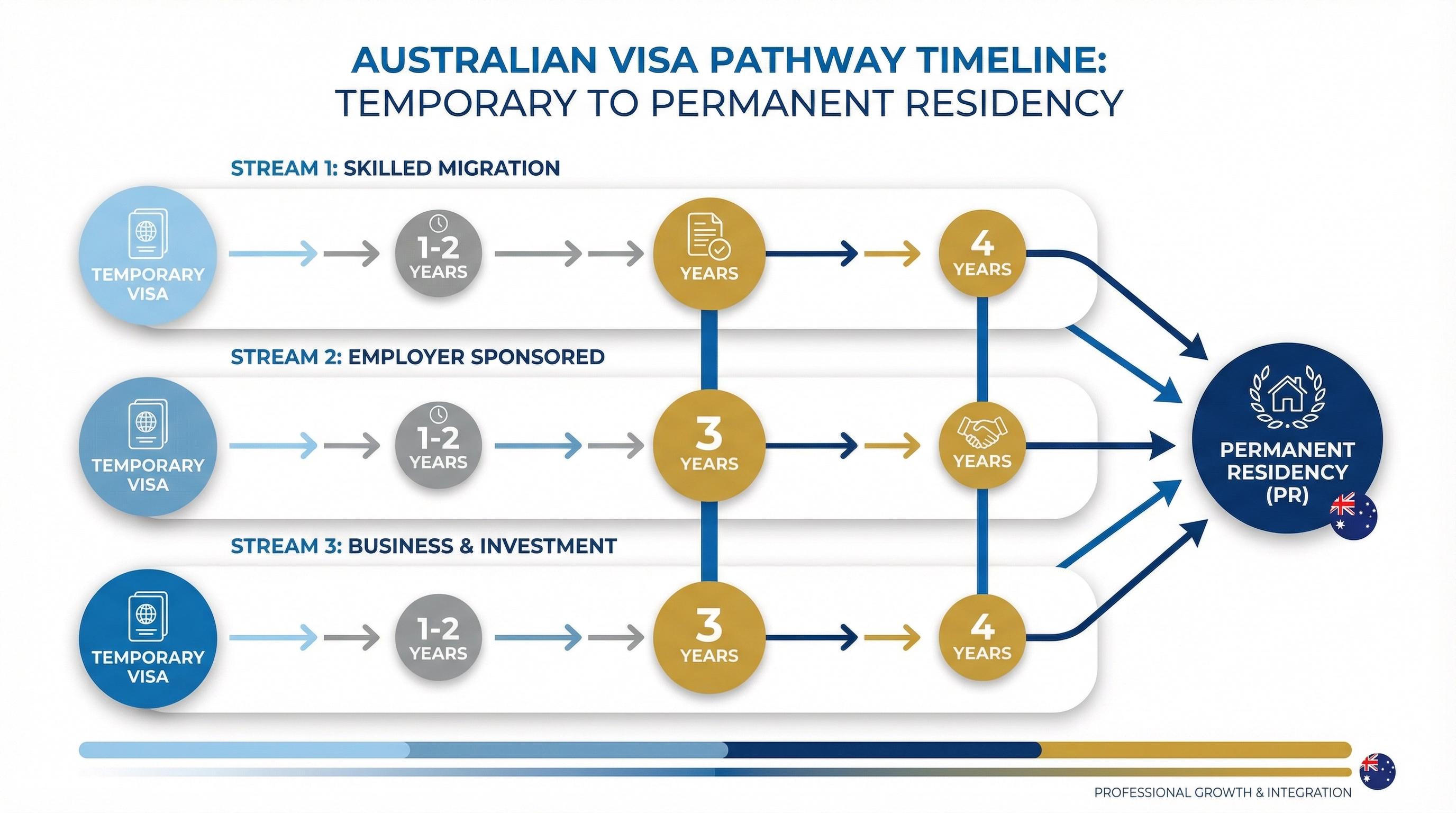
One of the most significant advantages of the Skills in Demand visa is the clear pathway to permanent residency. Understanding these pathways will help you plan your long-term career and life in Australia.
Specialist Skills Stream Pathway
If you are on the Specialist Skills stream, you can apply for permanent residency after three years of continuous employment with your sponsoring employer. The permanent residency pathway is through the Employer Nomination Scheme (ENS) subclass 186 visa.
Requirements:
- Three years of continuous employment in your nominated occupation
- Continued employment with the same employer (or a new employer willing to sponsor your permanent residency)
- Salary remains above the $135,000 threshold
- Continued skills assessment validity
- Meet health and character requirements
The three-year pathway is significantly faster than previous visa frameworks, making the Specialist Skills stream highly attractive for senior professionals.
Core Skills Stream Pathway
If you are on the Core Skills stream, you can apply for permanent residency after four years of employment. The pathway is also through the ENS subclass 186 visa.
Requirements:
- Four years of employment in your nominated occupation (does not need to be with the same employer)
- Current employer willing to sponsor your permanent residency application
- Salary remains above the minimum threshold
- Continued skills assessment validity
- Meet health and character requirements
The four-year pathway provides flexibility because you can change employers during this period as long as you remain in your nominated occupation. This is a significant improvement over previous visa frameworks that often tied workers to a single employer.
Essential Skills Stream Pathway
The Essential Skills stream does not offer a direct pathway to permanent residency through the Skills in Demand visa. Workers on this stream would need to transition to another visa category to pursue permanent residency.
For no-code tech professionals, this stream is generally not relevant, so we will not focus on it here.
How the Skills in Demand Visa Compares to the TSS (Subclass 482) Visa
The Skills in Demand visa replaces the TSS (subclass 482) visa, but there are several important differences that make the new visa more attractive for tech professionals.
Clearer Pathways to Permanent Residency:
The TSS visa had complex and often unclear pathways to permanent residency, with many workers finding themselves stuck in temporary visa cycles. The Skills in Demand visa provides structured, time-based pathways that give workers certainty about their future.
Higher Salary Thresholds:
The Skills in Demand visa has higher minimum salary requirements, particularly for the Specialist Skills stream. While this may seem like a disadvantage, it actually benefits skilled professionals by ensuring that salaries are competitive and reflect the value of their skills.
More Flexible Employer Changes:
Under the TSS visa, changing employers was complicated and often required starting the visa process over. The Skills in Demand visa allows for greater flexibility, particularly for Core Skills stream holders who can change employers while still progressing toward permanent residency.
Focus on In-Demand Skills:
The occupation lists for the Skills in Demand visa are more closely aligned with Australia's current economic needs. This means that occupations on the list are genuinely in demand, increasing job security and career opportunities for visa holders.
Application Process: Step-by-Step Guide
Applying for the Skills in Demand visa involves several steps, and the process can take several months from start to finish. Here is a step-by-step guide to help you navigate the process.
Step 1: Obtain a Skills Assessment
Before you can apply for the visa, you must obtain a positive skills assessment from the relevant assessing authority (typically the ACS for tech roles). This involves submitting your qualifications, employment references, and other supporting documents.
Timeline: 4-8 weeks Cost: Approximately $500-$600 AUD
Step 2: Secure Employer Sponsorship
You need a job offer from an approved Australian employer. If your employer is not yet an approved sponsor, they will need to apply for sponsorship approval first.
Timeline: Varies (can take 1-3 months depending on employer's readiness) Cost: Employer bears the cost of sponsorship approval
Step 3: Employer Submits Nomination
Once sponsorship is approved, your employer submits a nomination application for your specific position. This involves demonstrating that the role is genuine, meets salary requirements, and aligns with your skills assessment.
Timeline: 1-3 months Cost: Employer bears the cost (approximately $540 AUD)
Step 4: Submit Visa Application
After the nomination is approved, you can submit your visa application. This includes providing evidence of your identity, qualifications, English language proficiency, health, and character.
Timeline: 2-6 months Cost: Approximately $3,035 AUD (main applicant), plus additional fees for family members
Step 5: Health and Character Checks
You will undergo medical examinations and provide police clearance certificates as part of the visa assessment process.
Timeline: 2-4 weeks Cost: Varies depending on location and number of family members
Step 6: Visa Decision
Once all requirements are met, the Department of Home Affairs will make a decision on your visa application. If approved, you will receive your visa grant notice and can begin working in Australia (or continue working if you are already in the country). Total Timeline: 6-12 months from start to finish Total Cost: Approximately $4,000-$5,000 AUD (excluding employer costs)
Salary Expectations for No-Code Tech Roles Under the Skills in Demand Visa
Understanding salary expectations is crucial because the Skills in Demand visa has minimum salary thresholds that you must meet. Here is what you can expect for each no-code tech role.
Business Analyst:
- Entry to Mid-Level: $80,000 - $110,000 AUD
- Senior Level: $110,000 - $140,000 AUD
- Specialist Level: $140,000+ AUD
ICT Project Manager:
- Mid-Level: $100,000 - $130,000 AUD
- Senior Level: $130,000 - $160,000 AUD
- Specialist Level: $160,000+ AUD
Scrum Master:
- Mid-Level: $100,000 - $125,000 AUD
- Senior Level: $125,000 - $150,000 AUD
Change Manager:
- Mid-Level: $95,000 - $120,000 AUD
- Senior Level: $120,000 - $145,000 AUD
For the Core Skills stream, you need to meet the minimum salary threshold (currently around $73,150 AUD), which is easily achievable for mid-level professionals in these roles. For the Specialist Skills stream, you need to earn at least $135,000 AUD, which is attainable for senior professionals with several years of experience.
Tips for Immigrants Applying for the Skills in Demand Visa
Navigating the visa process as an immigrant can be challenging, but these tips will help you maximize your chances of success.
Start Early:
The visa process takes time, so start preparing as early as possible. Obtain your skills assessment, improve your English scores, and begin networking with potential employers well before you plan to apply.
Position Yourself for Mid-Level Roles:
Do not undersell yourself by targeting entry-level positions. The Skills in Demand visa is designed for skilled professionals, and employers are looking for candidates who can contribute immediately. Position your experience and skills to align with mid-level roles that meet the salary thresholds.
Leverage Your Existing Experience:
Your previous work experience—even if it was not in tech—can be positioned as relevant domain knowledge. If you worked in healthcare, target Business Analyst roles in healthcare organizations. If you have retail experience, look for opportunities in e-commerce companies.
Build an Australian Network:
Networking is critical for securing employer sponsorship. Join LinkedIn groups, attend industry events (virtually or in person), and connect with recruiters who specialize in placing immigrants. Many employers are more willing to sponsor candidates they have interacted with and trust.
Work with a Migration Agent:
While it is possible to apply for the visa yourself, working with a registered migration agent can significantly increase your chances of success. They can help you navigate complex requirements, avoid common mistakes, and ensure your application is as strong as possible.
Be Patient and Persistent:
The visa process can be frustrating, and there may be setbacks along the way. Stay focused on your goal, keep improving your skills, and do not give up. Thousands of immigrants successfully navigate this process every year, and you can too.
Common Mistakes to Avoid
Many visa applications are delayed or rejected due to avoidable mistakes. Here are the most common pitfalls and how to avoid them.
Incorrect Occupation Selection:
Choosing the wrong ANZSCO occupation can result in a negative skills assessment or visa refusal. Make sure your nominated occupation accurately reflects your actual duties and responsibilities, not just your job title.
Insufficient Employment Evidence:
Vague or incomplete employment references are a common reason for skills assessment failures. Ensure your references clearly outline your duties, responsibilities, and achievements in detail.
Underestimating English Requirements:
Do not assume your English is good enough without taking a test. Even if you are fluent, you need to provide official test scores. Prepare thoroughly and aim for scores above the minimum to strengthen your application.
Ignoring Labour Market Testing:
Employers must demonstrate that they have attempted to recruit locally before sponsoring you. Make sure your employer understands this requirement and completes it properly to avoid delays.
Incomplete Documentation:
Missing documents or incomplete forms are a major cause of delays. Double-check every requirement and provide all requested evidence upfront.
Conclusion: Your Pathway to a Permanent Future in Australia
The Skills in Demand visa represents a significant opportunity for Business Analysts, Project Managers, Scrum Masters, and Change Managers to build long-term careers in Australia. With clear pathways to permanent residency, competitive salary thresholds, and a focus on in-demand occupations, this visa is designed to attract and retain skilled professionals who can contribute to Australia's economy.
If you are currently working in a no-code tech role or planning to transition into one, now is the time to start preparing. Obtain your skills assessment, improve your English proficiency, build your professional network, and position yourself for mid-level roles that meet the visa requirements. The pathway to permanent residency is clearer than ever, and with the right preparation, you can achieve your goal of building a thriving career and life in Australia.
The opportunity is real. The pathway is clear. The time to act is now.
Ready to start your Skills in Demand visa journey?
Learn the skills you need to qualify for Business Analyst, Project Manager, Scrum Master, and Change Manager roles with our comprehensive no-code tech bootcamp. Get job-ready skills, Australian work experience, and career support designed specifically for immigrants.
